In today's digital era, social media platforms are not only used to communicate and share information, but are also a means of building an audience, developing personal branding, and making money from the content created.
 Continue ReadingZoyalink Invites Creators to Share Original Content Through the Creator Program
Two platforms that are often discussed are Facebook and Zoyalink. Even though both allow users to share content publicly, there are fundamental differences, especially in terms of monetization, opportunities for new creators, and account growth strategies.
Facebook is one of the largest social media platforms in the world with billions of active users. Meanwhile, Zoyalink is present as a social media and content monetization platform that focuses on helping creators get income opportunities from their digital works.
This article will fully discuss the differences between Facebook and Zoyalink and how the two can be combined to maximize traffic and creator income.
Facebook at a Glance
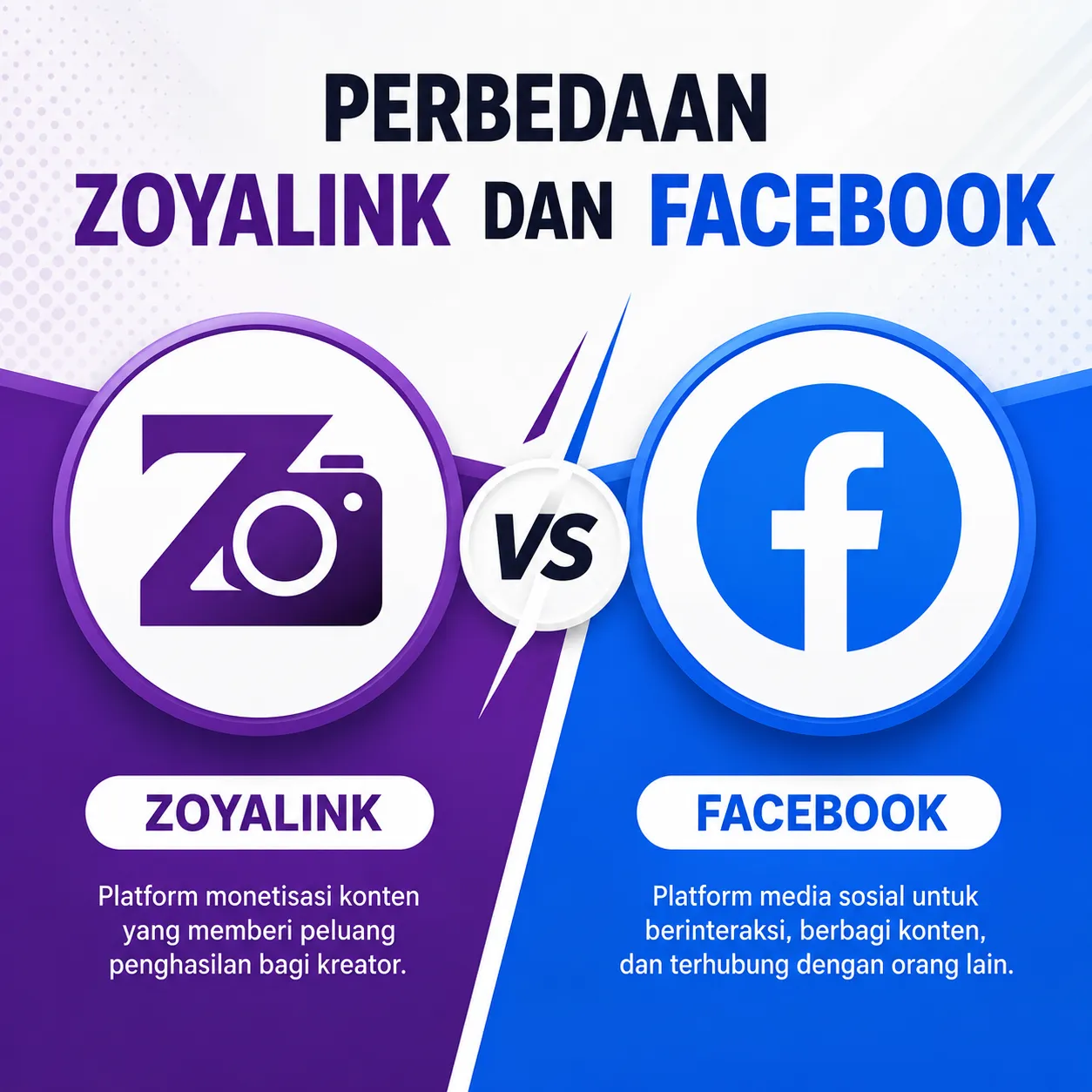
Facebook is a global social media platform that allows users to share status, photos, videos, community groups, marketplaces and various other social features.
With a very large number of users, Facebook is one of the largest sources of traffic on the internet.
Many creators use Facebook to build audiences, expand the reach of their content, and promote various products and services.
Overview of Zoyalink
Zoyalink is a social media and content monetization platform that allows users to upload photos, videos and various other types of digital content in one creator ecosystem.
Unlike many other platforms that focus on audience growth first before providing monetization opportunities, Zoyalink was built with the vision of providing more open opportunities for creators to start growing and generating income from their work.
Comparison of Facebook and Zoyalink
| Features | Zoyalink | |
|---|---|---|
| Number of Users | Very Large | Still Developing |
| Traffic Potential | Very High | Developing |
| Social Media | Yes | Yes |
| Upload Photo | Yes | Yes |
| Upload Video | Yes | Yes |
| New Creator Opportunities | Competitive | More Open |
| Monetization Focus | Selective | Creator Oriented |
Advantages of Facebook
Facebook has the main advantage of a very large number of users.
Every day billions of interactions occur on the platform, so the potential reach of the content is also very high.
Some of the advantages of Facebook include:
- Very large user base.
- High viral potential.
- Many community groups.
- Active marketplace.
- Complete social features.
- Large source of traffic.
Because of its large number of users, Facebook is one of the best places to build an audience.
Disadvantages of Facebook for New Creators
Even though Facebook has huge traffic, it also has a very high level of competition.
Every day millions of new content are published so new creators often have difficulty getting the attention of their audience.
Some of the challenges that new creators often face include:
- Competition is very tight.
- Difficult to build initial reach.
- Content is easily lost.
- Monetization has certain requirements.
- The algorithm is very competitive.
As a result, many novice creators need quite a long time before they start to get significant results.
The Advantages of Zoyalink in Monetization
If Facebook is superior in terms of number of users, then Zoyalink has the main advantage in its focus on creator monetization.
Zoyalink was built with a concept that is friendlier to creators who want to start building income from digital content.
Some of Zoyalink's advantages include:
- Focus on the creator ecosystem.
- Monetization of photo content.
- Monetization of video content.
- Monetization of various types of digital content.
- More opportunities are open for new creators.
- A system designed to support creator growth.
For novice creators, monetization opportunities are often an important factor. Not a few creators lose motivation because they have to wait too long before they can make money from their work.
This is where Zoyalink tries to provide a more attractive alternative for creators who want to start building a digital portfolio as well as income opportunities.
 Continue ReadingZoyalink Announces 2026 Feature Update, Brings Dark Mode and Titles for Image and Video Content
Current Weaknesses of Zoyalink
Each platform certainly has advantages and disadvantages.
One of Zoyalink's main challenges at the moment is that the number of users is still smaller than Facebook, which has been growing for years and has a very large global user base.
Because of this, the volume of organic traffic on Facebook is still much greater than Zoyalink.
However, this condition is normal for a platform that is still in its growth stage.
As more users and creators join, Zoyalink's growth potential also continues to increase.
Best Strategy: Facebook and Zoyalink Used Together
Many creators think they have to choose one platform. However, in practice, a more effective strategy actually combines the two.
Facebook can be used as a traffic engine because it has a very large number of users.
Meanwhile Zoyalink can be used as a content monetization center.
This strategy allows creators to benefit from both platforms at once.
Example of Collaboration Strategy
- Upload photos or videos to Zoyalink.
- Get content links from Zoyalink.
- Share the link on Facebook.
- Take advantage of relevant Facebook groups.
- Take advantage of your Facebook page.
- Direct your Facebook audience to content on Zoyalink.
In this way, creators can take advantage of the large amount of Facebook traffic while directing visitors to monetized content on Zoyalink.
Why Is This Strategy Interesting?
Many successful creators understand that traffic and monetization are two different things.
Facebook is powerful in generating reach and engagement.
Zoyalink focuses on developing the creator ecosystem and content monetization.
When both platforms are used together, creators can achieve a complementary combination.
| Destination | Platform |
|---|---|
| Searching for Traffic | |
| Building an Audience | Facebook & Zoyalink |
| Content Monetization | Zoyalink |
| Building a Portfolio | Zoyalink |
Who is Suitable to Use Zoyalink?
Zoyalink is suitable for use by:
- Photo creator.
- Video creator.
- Blogger.
- Beginning digital creators.
- Influencers.
- Community owner.
- Online business people.
The platform is designed to help creators build a digital presence while taking advantage of available monetization opportunities.
The Future of Digital Creators
The development of the digital economy shows that creators no longer depend on just one platform.
Multi-platform strategies are becoming increasingly important because they allow creators to gain traffic from various sources while increasing revenue opportunities.
Combining Facebook as a traffic source and Zoyalink as a monetization platform can be an attractive strategy for creators who want to grow faster.
Conclusion
Facebook and Zoyalink have their respective advantages. Facebook is superior in terms of the number of users and huge traffic potential. However, the competition in it is also very tight, so new creators often take longer to develop.
On the other hand, Zoyalink comes with a stronger focus on creators and content monetization. Even though the number of users currently is still smaller than Facebook, this platform provides more open opportunities for creators who want to start building income from their digital work.
 Continue ReadingAdvantages and Disadvantages of the Creator Program at Zoyalink
Instead of choosing one, the best strategy is to combine both. Use Facebook to drive traffic and build an audience, then direct visitors to monetized content on Zoyalink. With this approach, creators can take full advantage of the power of both platforms to build long-term growth and revenue.