Laporkan konten ini jika melanggar ketentuan, mengandung materi sensitif, atau hak cipta.
Astronomers Estimate That The Observable Universe Could Contain Around 40
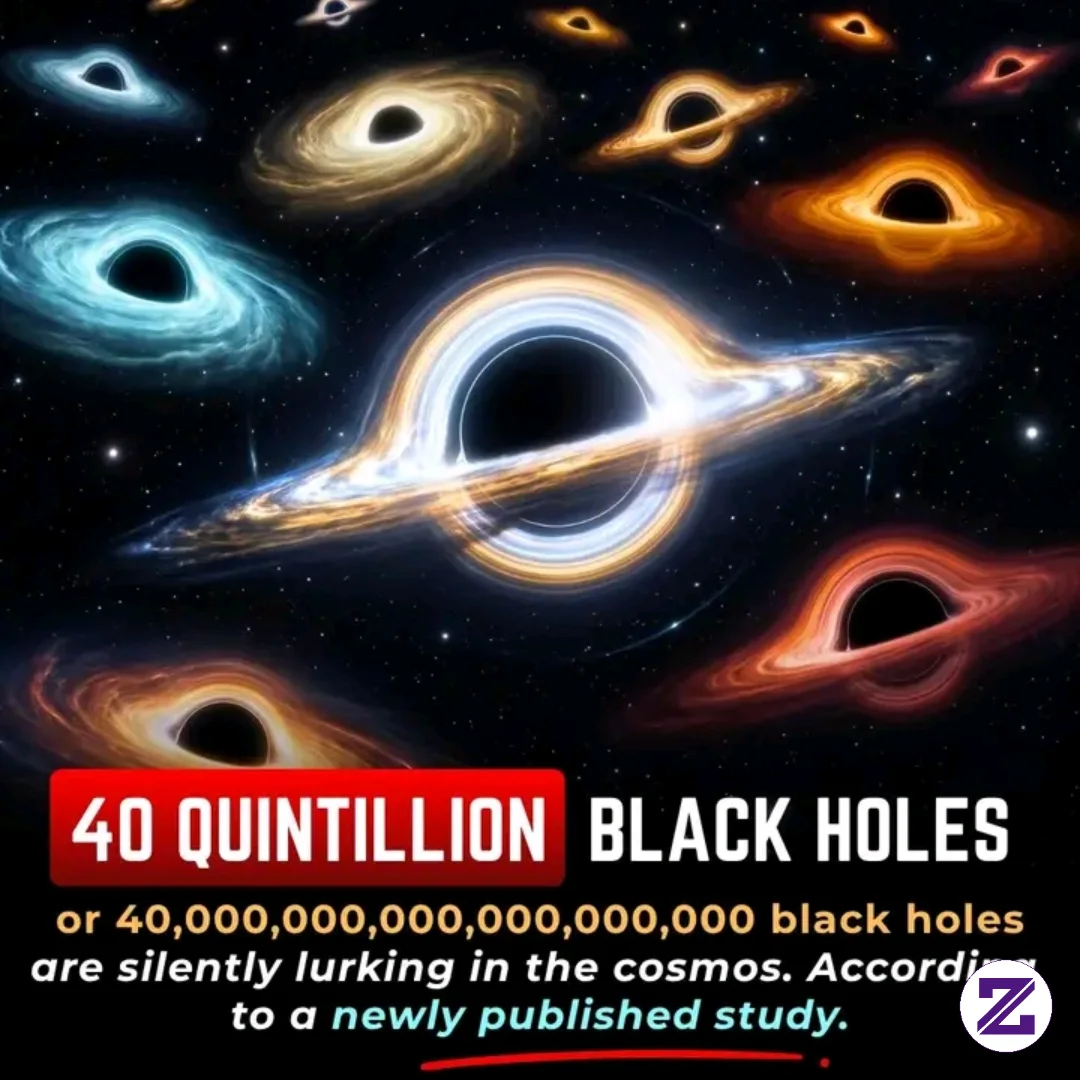
Quintillion Stellar-mass Black Holes. That’s About 4 × 10¹⁹ Black Holes. ⸻
⭐ These are predominantly the remnants of massive stars that ended their lives and collapsed under gravity. The estimate comes from modeling how stars and binary star systems form, evolve, and eventually produce black holes across cosmic history.
⸻
⚫ Together, these stellar-mass black holes are estimated to account for roughly 1% of the universe’s ordinary (baryonic) matter. Most are not directly observed because black holes emit no light of their own and can be extremely difficult to detect.
⸻
🌌 These black holes are spread throughout galaxies across the observable universe. Many are expected to be isolated, meaning they have no nearby companion star feeding them gas, making them extremely difficult to detect. Others can reveal themselves through their effects on surrounding stars, gas, or space itself.
⸻
🔭 A small fraction can be detected through dramatic events. When a black hole is part of a binary system, it can pull material from its companion star, producing powerful X-rays. Scientists can also identify otherwise invisible black holes by observing how their gravity bends light or affects the motion of nearby stars.
⸻
🔭 Scientists therefore don’t know the exact number. The 40-quintillion figure is a theoretical population estimate based on models of star formation, stellar evolution, galaxy properties, and black-hole formation—not a direct census of individual black holes.
⸻
🕳️ The estimate also highlights how different the universe looks from what we can directly observe. Thousands of black holes have been identified or strongly inferred, but the vast majority of the predicted stellar-mass population may remain completely invisible to current telescopes. Future gravitational-wave observatories and more sensitive astronomical surveys could reveal many more.
#Source: The Astrophysical Journal
Advertisement